What South Florida Residents Should Know About Hepatitis C
Hepatitis C is a virus that mostly affects the liver, and it is one of the quieter health concerns in South Florida because it rarely announces itself. Someone can carry it for years, feel completely fine, and have no idea anything is wrong until a routine screening or a liver problem turns up the answer. That silence is exactly why testing matters, and it is exactly why the news on the treatment side is so good: Hepatitis C is curable today, in most cases with a course of pills you take at home over a matter of weeks.
This guide is written for Broward, Miami-Dade and Palm Beach residents who have questions about Hepatitis C testing and treatment, whether the question is "should I get tested" or "I already know I have it, now what." We will walk through how testing actually works, why the cure available today is nothing like the treatment older generations remember, what it costs, who the CDC says should be screened, and why getting your testing and your treatment in the same place changes the outcome.
Here is the shape of what is ahead:
- Testing is a two-step process. One test checks for past exposure, a second confirms whether the virus is still active.
- Treatment is short. Most people finish in 8 to 12 weeks of oral medication.
- Cure rates are very high. Well over 90 percent in modern practice, with side effects that are typically mild.
- Cost should not be the reason you wait. Insurance, Medicaid and a Sliding Fee Scale are available.
- Screening and treatment work best under one roof. A positive result should lead directly to a plan, not a referral into the unknown.
First Circle Medical Center is a 501(c)(3) nonprofit community medical office in Margate, operated by The Snyder Foundation, serving Broward, Miami-Dade and Palm Beach Counties in person, with telemedicine reaching patients statewide across Florida. We offer Hepatitis C screening and full treatment on-site, which means the same clinic that tests you can also treat you with direct-acting antivirals and confirm your cure. In this guide we will walk through the whole process the way we would explain it to you in the room.
How Hepatitis C Testing Works, Step by Step
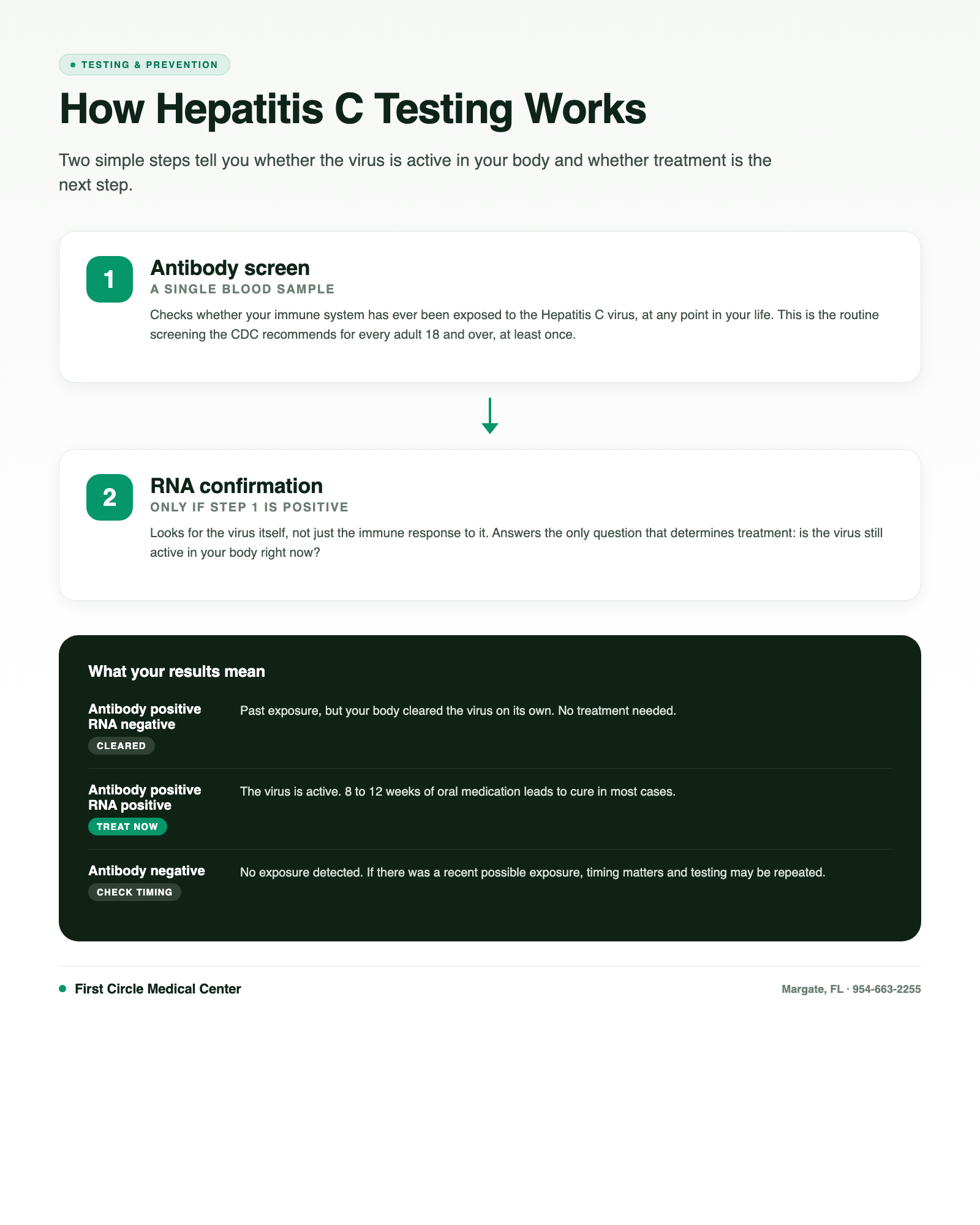
When people hear "Hepatitis C test," they usually picture one test with one result. In practice it is a two-step pathway, and understanding the two steps clears up almost every question that comes up during a visit.
The antibody screen
The first step is an antibody test. It looks for antibodies your immune system produces if you have ever been exposed to the Hepatitis C virus, at any point in your life. It is usually done from a blood sample, and it is the same kind of screening the CDC recommends every adult get at least once.
A positive antibody test does not automatically mean you currently have Hepatitis C. It means your body was exposed at some point. Some people's immune systems clear the virus on their own without ever needing treatment, and their antibody test can stay positive for life even though the virus itself is gone. That is exactly why a second test exists.
The RNA confirmation
If the antibody screen comes back positive, the next step is an RNA test, sometimes called a PCR test. This one looks for the virus itself, not just the immune response to it. It answers the only question that actually determines whether you need treatment: is the virus still active in your body right now.
- Antibody positive, RNA negative: you were exposed in the past and your body cleared the virus on its own. No treatment needed, though it is worth talking through what that history means for you.
- Antibody positive, RNA positive: the virus is active. This is the result that leads to treatment.
- Antibody negative: no exposure detected. If you have had a recent possible exposure, timing matters, since it takes time for antibodies to develop.
Because there is a gap between exposure and the point at which a test can reliably detect it, mention any specific recent exposure when you book. That one sentence helps your provider decide when to test and what to test for, and it is a routine conversation, not an uncomfortable one.
The Cure, and Why It Is Not the Treatment You May Have Heard About
If the phrase "Hepatitis C treatment" brings to mind something long, exhausting and hard to get through, you are thinking of the old treatment, and it genuinely does not exist anymore. That old memory is one of the biggest reasons people avoid getting tested, and it is worth clearing up directly.
For years, the standard Hepatitis C treatment was built around interferon, an injected medication that often had to be combined with other drugs for six months to a year. It caused flu-like symptoms, fatigue, and mood changes severe enough that many patients could not finish the course, and cure rates were far from guaranteed even for those who did. A lot of people who were told to consider treatment back then made a reasonable decision to wait, and many of them have never revisited that decision since.
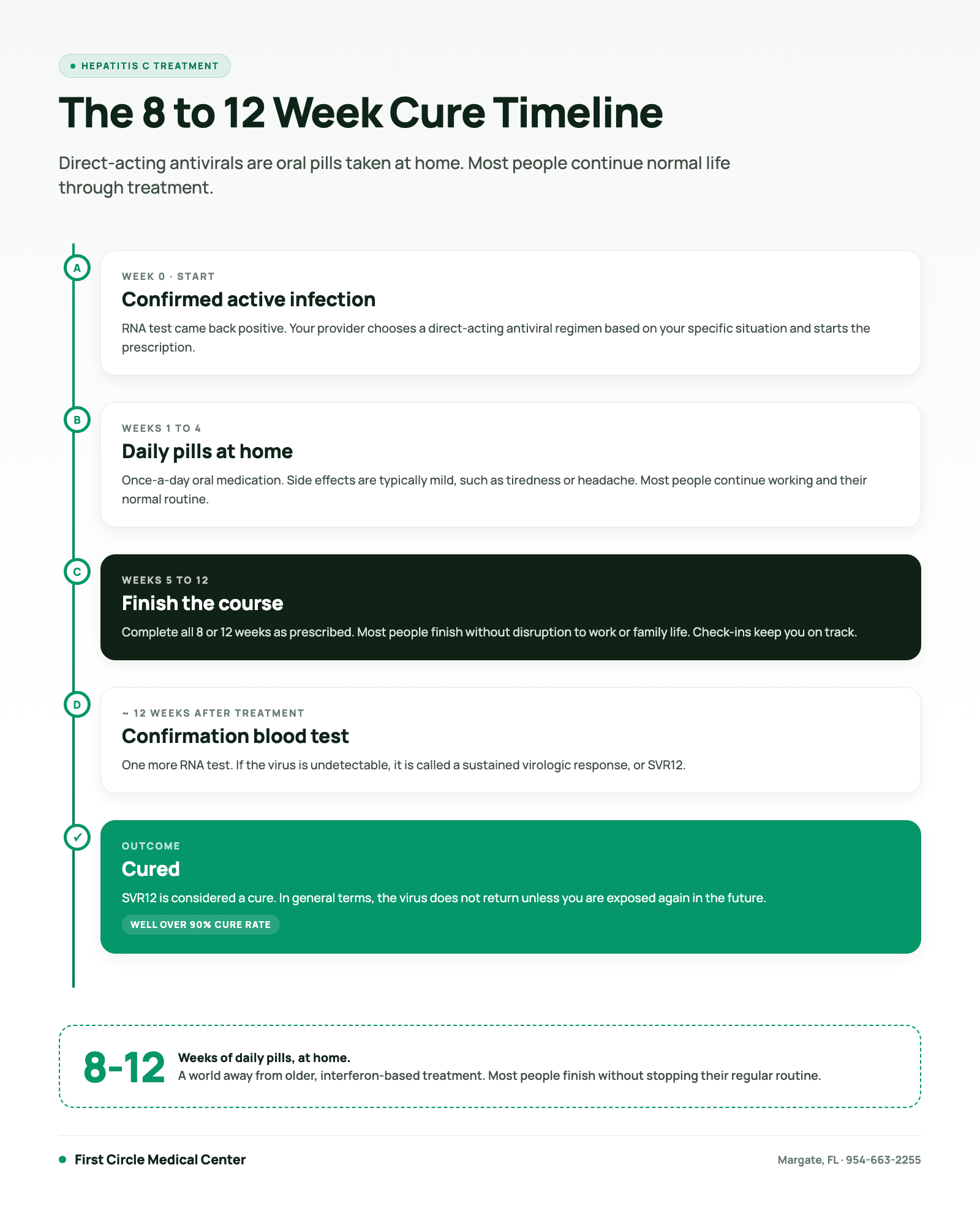
Since around 2014, direct-acting antivirals, or DAAs, have replaced interferon-based treatment almost entirely. DAAs are oral medications, taken as pills at home, usually once a day for 8 or 12 weeks depending on the specific medication and your situation. They work by directly targeting the virus rather than relying on your immune system to do the heavy lifting, and in modern practice cure rates are well over 90 percent. Side effects are typically mild, things like tiredness or headache rather than the disruptive symptoms older regimens caused.
How you know it worked
Finishing the medication is not the last step. About 12 weeks after treatment ends, you come back for another RNA test. If the virus is undetectable at that point, it is called a sustained virologic response, or SVR12, and it is considered a cure. In general terms, the virus does not return after that unless you are exposed again in the future.
That confirmation test matters. It is the difference between finishing a prescription and actually knowing you are cured, and it is part of why screening and treatment under one roof works better than treatment alone: the same clinic that started your care can follow you all the way to that final answer.
What Treatment Costs in South Florida
Cost is the question that keeps the most people from calling, and it is usually more workable than expected. Hepatitis C testing and DAA treatment are covered by Medicare, Medicaid, and most commercial insurance plans. If you are uninsured, First Circle Medical Center offers a Sliding Fee Scale based on what you can afford, and no one is turned away based on ability to pay.
Where you go for care also affects your cost, and more importantly, whether that care actually leads anywhere. Here is how the common options in South Florida compare.
| Option | Typical cost | Treats Hep C on-site | Best for |
|---|---|---|---|
| Nonprofit community medical office | Insurance accepted; Sliding Fee Scale if uninsured | Yes, screening through DAA treatment and cure confirmation | Most people, especially without insurance |
| Hospital hepatology department | Specialist copay, often higher | Yes, with specialist-level monitoring | Advanced liver disease or complex cases |
| Urgent care | Visit fee plus lab charges | No, screening only, refers out for treatment | An initial screen when nothing else is open |
| At-home mail-in kit | Paid out of pocket, per kit | No, screening only | A first answer when you are not ready to visit a clinic |
The detail worth paying attention to is whether the place that tests you can also treat you. An urgent care visit or a mail-in kit can tell you that you have been exposed, and then you are back to finding a clinic, booking an appointment, and starting the conversation over. A clinic that offers both closes that gap. A positive result becomes the first day of an 8 to 12 week plan instead of a referral you have to chase down yourself.
If you want to talk through your specific coverage before you book, call 954-663-2255. One phone call gets you a straight answer, and nobody is going to interrogate you about how you ask.
Who Should Get Screened, and How Often
The CDC recommends that every adult 18 and older get tested for Hepatitis C at least once, and that every pregnant person be tested during each pregnancy. That is universal guidance, not something limited to a particular age group or background. People with ongoing risk factors should be tested more often than once.
For a long time, screening guidance focused heavily on baby boomers, people born between 1945 and 1965, because that generation carried a disproportionate share of undiagnosed cases. That history is still true, and it is still worth knowing if you fall into that group. But current CDC guidance has moved to universal adult screening, because Hepatitis C does not stay confined to one generation, and a one-time test at any age is a small ask against years of not knowing.
Risk factors that call for more frequent testing
Anyone can benefit from a one-time screening, but the following situations are reasons to test more than once, or to bring it up specifically when you book:
- Injection drug use, past or present, including any history of sharing needles or other equipment.
- A blood transfusion or organ transplant before 1992, before current screening standards were in place.
- Tattoos or piercings done in unregulated settings, where equipment sterilization cannot be confirmed.
- HIV coinfection, since the two conditions are frequently linked.
- Being born to a mother with Hepatitis C, which carries a risk of transmission at birth.
None of these require you to explain yourself in detail to get tested. A short, honest answer to "does any of this apply to you" is enough for your provider to know how to proceed, and it is a conversation our team has every day without reaction.
Why a Nonprofit Community Medical Office Matters for Hep C Care

Hepatitis C care works best as a continuous relationship, not a series of disconnected appointments. Screening tells you something. Treatment acts on it. A confirmation test a few months later tells you whether it worked. When all three steps happen through the same clinic, nothing gets lost in the handoff between one office and the next, and no one has to retell their history from scratch at each stop.
A nonprofit community medical office is also built around a different incentive than a lot of the healthcare system. First Circle Medical Center is not structured to maximize what a single visit generates. It is structured to get more people in Broward, Miami-Dade and Palm Beach tested, treated and cured. What that looks like in practice:
- Cost is workable by design. Sliding fee scale for uninsured patients, and no one turned away based on ability to pay.
- Care does not stop at the result. Screening, DAA treatment, and chronic disease coordination sit under one roof, alongside a regular doctor for everything else going on with your health.
- Judgment-free is how the team operates, not a phrase on the wall. Risk factors, past history, none of it is new to us.
- We are local. Margate, minutes from Coconut Creek and Coral Springs, serving the tri-county area.
What to bring to your first visit
- Any prior test results you have. A past antibody or RNA result, even from years ago, helps your provider pick up where things left off.
- A rough sense of your history. Approximate dates matter more than exact ones, and it is fine to say "I am not sure."
- Your insurance card, or none at all. Either way, ask about cost up front so nothing is a surprise later.
- Your questions, written down if that helps. There is no such thing as a question our team has not heard before.
If you are ready to talk to someone, you can see the full list of what we offer on our Hepatitis C treatment page, or call to ask questions before you decide anything.
Frequently Asked Questions About Hepatitis C in South Florida
Where can I get Hepatitis C testing and treatment in South Florida?
First Circle Medical Center offers Hepatitis C screening and full on-site treatment at 101 N State Road 7, Suite 103, Margate, FL 33063, open Monday through Friday from 9:00 AM to 5:00 PM. Call 954-663-2255 to book. We serve patients across Broward, Miami-Dade and Palm Beach Counties.
How much does Hepatitis C treatment cost if I do not have insurance?
We offer a Sliding Fee Scale for uninsured patients, based on what you can afford, and no one is turned away based on ability to pay. If you do have coverage, we accept Medicare, Medicaid and most insurance plans. Call before your visit and we will go through your specific situation with you.
Is Hepatitis C really curable?
Yes. With modern direct-acting antiviral medication, most people are cured after 8 to 12 weeks of daily pills. Cure rates in current practice are well over 90 percent, confirmed with a follow-up RNA test about 12 weeks after treatment ends.
What are the side effects of the modern Hepatitis C medication?
Direct-acting antivirals are much easier to tolerate than older interferon-based treatment. Side effects are typically mild, such as tiredness or headache, rather than the severe, flu-like symptoms older regimens were known for. Your provider will walk through what to expect for your specific medication.
Do I need symptoms to get tested?
No. Many people carry Hepatitis C for years with no symptoms at all, which is exactly why the CDC recommends every adult get tested at least once regardless of how they feel. Testing is routine preventive care, not something reserved for when something feels wrong.
Can I keep working during treatment?
Most people continue their normal routine, including work, throughout treatment. Because DAAs are oral medication taken at home with generally mild side effects, treatment does not typically require time off or a disruption to daily life the way older treatments sometimes did.
The Short Version
Hepatitis C testing is quick, and Hepatitis C treatment today is not the ordeal it used to be. Two simple tests tell you where you stand, and if treatment turns out to be the next step, it is a matter of weeks of pills, not months of misery, with a real cure at the end of it and a test to prove it.
If you have been putting off a test, or you already know you have Hepatitis C and have been putting off treatment because of what it used to mean, this is a good week to make the call. Reach us at 954-663-2255, or request an appointment online. We will walk you through testing, cost, and what treatment actually looks like, without any of it feeling like a bigger deal than it needs to be.
Sources: Screening and treatment guidance is drawn from the U.S. Centers for Disease Control and Prevention, Hepatitis C.
This article is for general information and is not medical advice. Please speak with a qualified healthcare provider about your individual situation.