What Every Margate Resident Should Know About STD Testing

STD testing is a routine screening for sexually transmitted infections, and it is one of the most ordinary things a clinic does. It is preventive care in the same category as a blood pressure check or a cholesterol panel. Despite that, it is one of the most postponed appointments in healthcare, usually for reasons that have nothing to do with medicine and everything to do with embarrassment, cost, or simply not knowing what the visit involves.
Testing available at a community health center generally covers:
- HIV testing with counseling before and after
- Chlamydia and gonorrhea screening, the two most commonly reported STDs in the United States
- Syphilis screening, which has been rising nationally for over a decade
- Hepatitis C screening, often paired with other testing
- PrEP evaluation for people who want to prevent HIV rather than only test for it
Before you book, these are the things worth thinking through:
- Symptoms are not a reliable signal. Most STDs produce none at all.
- Cost and coverage. What you pay depends heavily on where you go, not just on what you are tested for.
- Confidentiality. Who sees the result, and how it reaches you.
- What happens next. A test is only useful if the place you take it can act on the answer.
- Timing. Some infections are not detectable immediately after exposure.
By the end of this guide you will know how often the CDC says someone in your situation should be tested, how the options in Broward County actually differ, what testing costs if you are uninsured, and exactly what a visit looks like from the phone call to the results.
First Circle Medical Center is a 501(c)(3) nonprofit community medical office in Margate, operated by The Snyder Foundation, serving Broward, Miami-Dade and Palm Beach Counties in person, with telemedicine reaching patients statewide across Florida. We provide confidential STD and HIV testing, counseling, Hepatitis C screening and PrEP prevention programs. In this guide we will walk you through the whole process the way we would explain it to you across the desk, without the euphemisms.
The Main Types of STD and HIV Testing
There is no single test called "the STD test." What people mean by that phrase is a panel, a set of individual tests chosen based on your history, your anatomy, and what you have been exposed to. This matters practically: two people can walk into the same clinic on the same day and correctly leave with different tests. A good visit starts with a short conversation, not a default menu.
That conversation matters more in South Florida than in most of the country. Florida has consistently ranked among the states with the highest rates of new HIV diagnoses, and Broward County in particular has been a long-standing focus of state and federal prevention efforts. Testing here is not an unusual request. It is a normal part of how the county stays healthy.
Screening tests versus diagnostic tests
A screening test is what you get when nothing is wrong and you are checking anyway. It is the default for most people and it is the whole basis of the CDC's recommendations. A diagnostic test is what happens when there is a specific symptom or a known exposure to explain. The lab work can look identical. The difference is why you are there, and it can affect how your insurance processes the claim.
- Blood samples are used for HIV, syphilis and hepatitis screening.
- Urine samples are commonly used for chlamydia and gonorrhea.
- Swabs may be used depending on the infection and the site being tested.
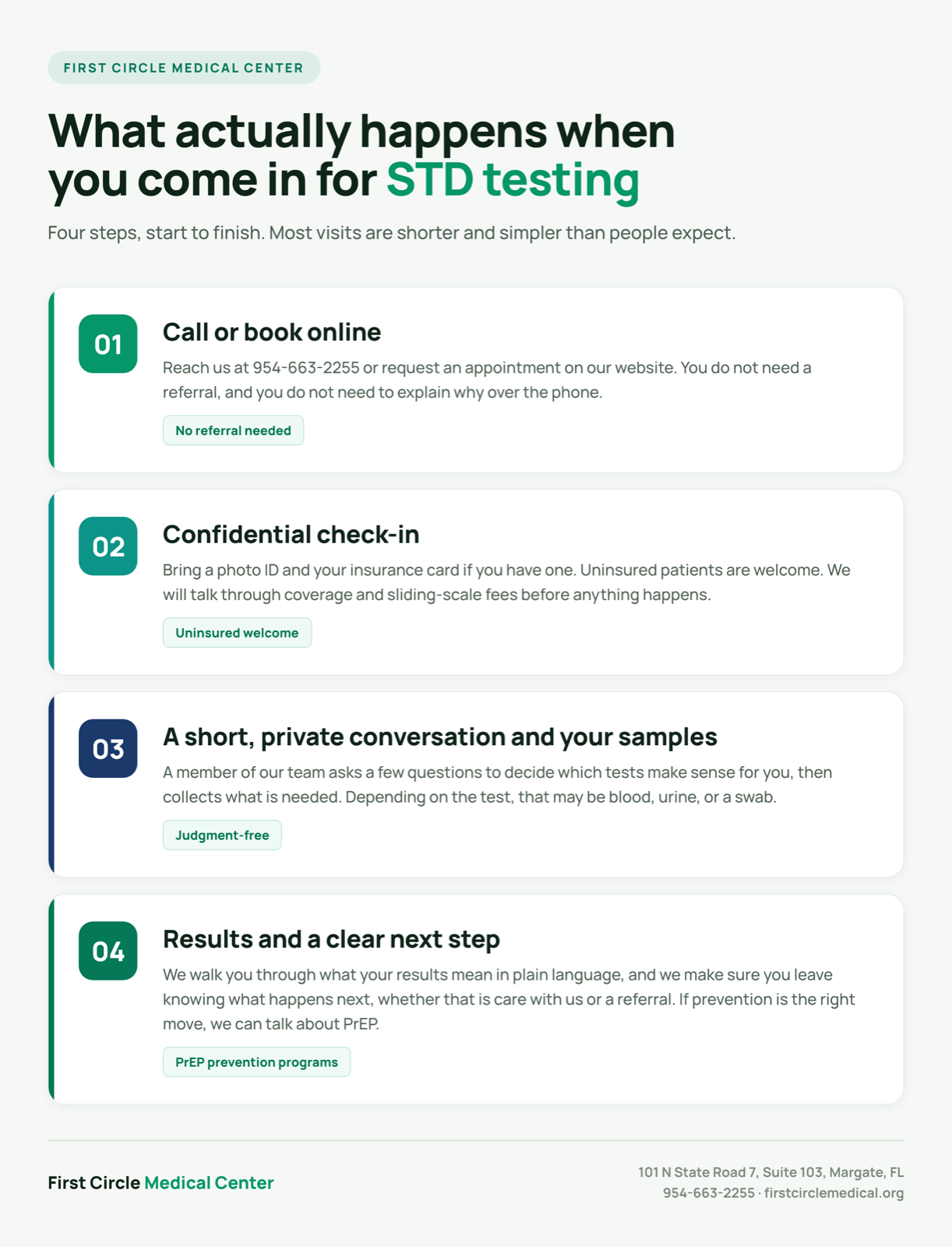
- Turnaround varies by the specific test and the lab that processes it, so ask at your visit rather than assuming.
None of this is painful, and none of it takes long. The part people dread is almost never the part that actually happens.
The window period, and why timing matters
Infections are not detectable the instant they are transmitted. Every test has a window period, the gap between exposure and the point at which a test can reliably find something. Testing too early can produce a negative result that is not actually reassuring. If you are testing because of a specific recent exposure, say so when you book. That single sentence changes which tests are appropriate and when you should come in, and it is exactly the kind of thing our team is used to hearing without reaction.
How to Choose Where to Get Tested in Broward County
This is where most people get stuck, because the options look interchangeable from the outside and are not. Here is how they actually compare.
| Option | Typical cost | Strengths | Best for |
|---|---|---|---|
| Nonprofit community health center | Insurance accepted; Sliding Fee Scale if uninsured | Testing, counseling, prevention and follow-up care in one place | Most people, especially without insurance |
| County health department | Low cost or no cost programs | Public health programs and partner services | Budget-first testing when you can work around hours |
| Urgent care | Visit fee plus lab charges | Evening and weekend availability | Symptoms that need attention right now |
| At-home mail-in kit | Paid out of pocket, per kit | Complete privacy, no appointment | Screening only, when nothing needs treating |
| Primary care provider | Standard copay | Continuity with your medical record | Adding testing to a physical you already scheduled |
The single most useful thing to look for is whether the place that tests you can also treat you or connect you to treatment. A mail-in kit can tell you something important and then leave you holding it, at which point you still have to find a clinic, book an appointment, and repeat the conversation. A community health center closes that loop. When your result and your next step live in the same building, a positive result becomes a plan instead of a crisis.
Worried about the cost? Practical steps
Cost is the most common reason people delay, and it is the most fixable one.
- Call and ask before you book. One phone call to 954-663-2255 gets you a straight answer about your specific situation. Nobody is going to interrogate you.
- Ask specifically about the Sliding Fee Scale if you are uninsured. At First Circle, fees slide based on what you can afford, and no one is turned away based on ability to pay.
- Check your plan before you assume it will not cover it. We accept Medicare, Medicaid, UnitedHealthcare, Blue Cross Blue Shield, Aetna, Humana and most other plans. Preventive screening is frequently covered at little or no cost to you.
- Do not skip the visit to save the copay. Untreated infections cost far more later, in money and in health. If cost is the barrier, say so out loud and let us solve it with you.
You can see the full list of what we offer on our testing and prevention services page, including HIV counseling and PrEP.
No symptoms versus symptoms: understanding the difference
If you have symptoms, such as unusual discharge, pain when urinating, sores, or unexplained pelvic or abdominal pain, that is a reason to be seen promptly rather than to schedule a routine screening. Symptoms do not mean the situation is dire, but they do change the urgency and they change which tests make sense.
If you have no symptoms, you are in the same position as the overwhelming majority of people who get tested, and you should still go. Screening exists precisely because symptoms are such a poor early warning system. The absence of symptoms tells you very little, and waiting for one is how an easily treated infection becomes a complicated one.
Testing for Every Situation

People come in for very different reasons, and the right approach differs with them:
- Nothing in particular prompted it. This is routine screening and it is the most common reason of all. Follow the CDC schedule for your age and situation and treat it like any other annual health task.
- Something specific happened. A new partner, a broken condom, a relationship ending, or an exposure you know about. Mention the timing when you book so your visit is scheduled correctly around the window period.
- You want to prevent, not just detect. If your goal is to stay HIV negative, testing is the entry point to a prevention conversation, including PrEP.
Three levels of engagement, from a single test to ongoing prevention
Not everyone needs the same depth of care, and it helps to know which one you are asking for:
- A one-time screening. You get tested, you get your results, you move on. Right for most people meeting a routine CDC recommendation.
- Regular scheduled testing. Every 3 to 12 months depending on your situation. Right for anyone with ongoing risk factors, where a single test is only a snapshot of one moment.
- An ongoing prevention program. PrEP with the regular monitoring that goes alongside it. This is a continuing relationship with a provider rather than a visit, and it is the most protective option available for people at substantial risk of HIV.
Confidentiality, in specific terms
Your visit and your results are protected health information under HIPAA. In practice, that means the details of your care are not disclosed without your authorization, aside from the narrow circumstances the law itself requires. If you have a particular concern, such as how results are communicated or who might see a statement, raise it at check-in. These are common questions and there are usually straightforward answers. Nobody has ever been judged here for asking.
Why a Community Health Center Makes a Difference
If you have put this off, it was probably not because you did not know testing existed. It is more likely that somewhere in the back of your mind you expected to be judged, to be handed a bill you could not pay, or to sit in a waiting room feeling conspicuous. Those are reasonable fears, and they are exactly what a nonprofit community medical office is structured to remove. We are not built to maximize a margin on your visit. We are built to get more people in the county tested.
What that means concretely:
- Cost is negotiable by design. Sliding fee scale for uninsured patients, and no one turned away based on ability to pay.
- Testing is not a standalone product. Counseling, Hepatitis C screening and PrEP prevention programs sit alongside it, so your result leads somewhere.
- Judgment-free is an operating standard, not a slogan. Our team does this every day, and there is nothing you can say that will surprise anyone.
- We are local and we stay local. Margate, minutes from Coconut Creek, Coral Springs and North Lauderdale, serving Broward, Miami-Dade and Palm Beach.
Getting the most out of your visit
- Write down your dates beforehand. Approximate timing of a possible exposure, and roughly when you were last tested. You do not need to be precise, but it helps.
- Say what you actually want. "I want to be tested for everything" is a perfectly good opening sentence, and our team will narrow it down with you.
- Ask what is not included. Panels vary. If you specifically want to be checked for something, name it rather than assuming it is standard.
- Book the follow-up before you leave. Whether that is a result conversation, a repeat test after the window period, or a PrEP discussion, put it in the calendar while you are still standing there.
When you are ready, you can request an appointment online or call us at 954-663-2255.
Frequently Asked Questions About STD Testing in Margate
Where can I get STD testing in Margate, FL?
First Circle Medical Center provides confidential STD and HIV testing at 101 N State Road 7, Suite 103, Margate, FL 33063, open Monday through Friday from 9:00 AM to 5:00 PM. Call 954-663-2255 to book. We are a few minutes from Coconut Creek, Coral Springs and North Lauderdale.
How much does STD testing cost if I do not have insurance?
We offer a Sliding Fee Scale for uninsured patients, which means the cost is based on what you can afford, and no one is turned away based on ability to pay. If you do have coverage, we accept Medicare, Medicaid and most insurance plans. Call before your visit and we will go through your specific situation with you.
How often should I get tested?
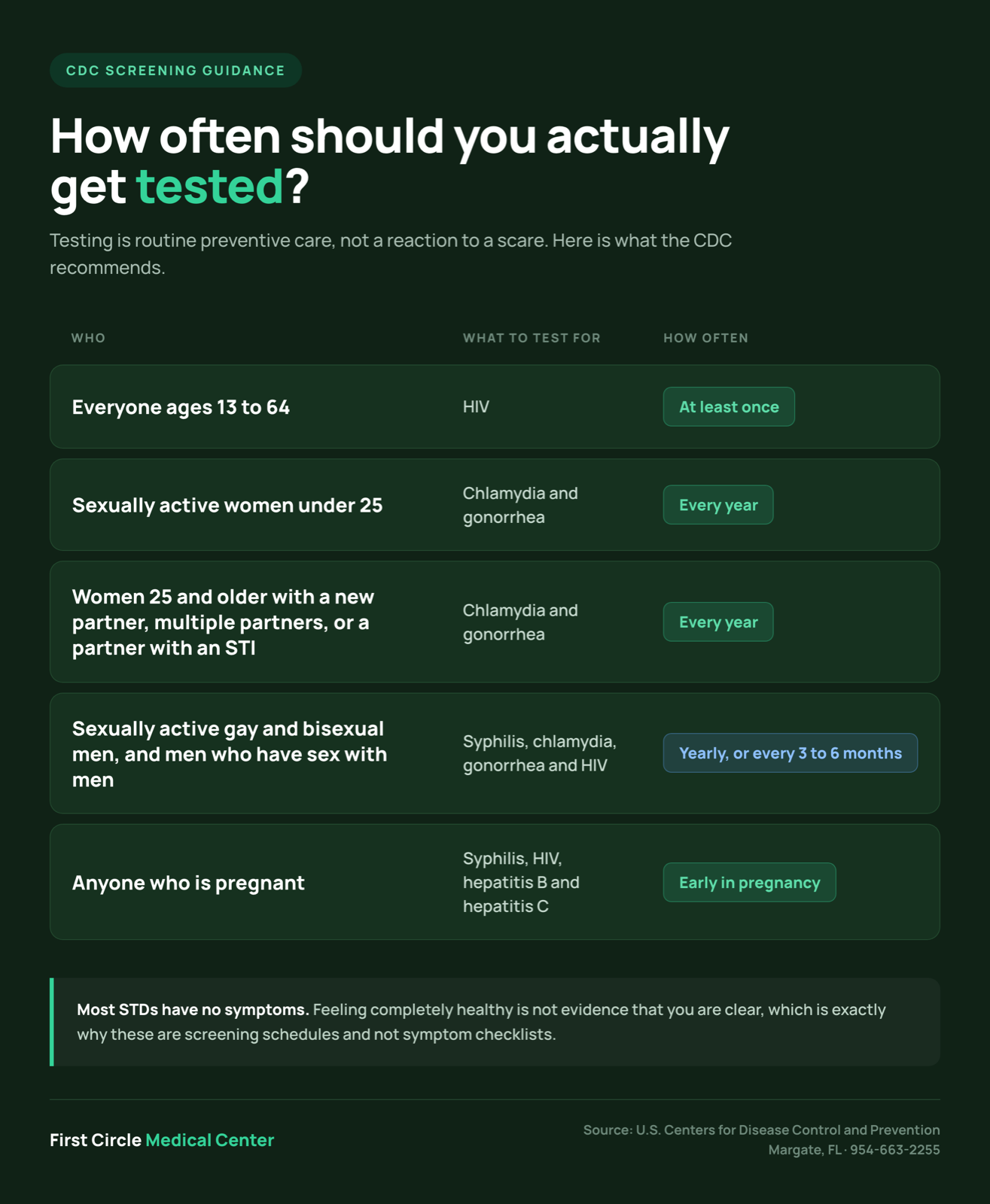
It depends on your age and circumstances. The CDC recommends:
- Everyone aged 13 to 64 should be tested for HIV at least once.
- Sexually active women under 25 should be tested for chlamydia and gonorrhea every year.
- Women 25 and older with a new partner, multiple partners, or a partner with an STI should be tested every year.
- Sexually active gay and bisexual men should be tested at least yearly, and every 3 to 6 months with multiple partners.
- Anyone who is pregnant should be tested for syphilis, HIV, hepatitis B and hepatitis C early in pregnancy.
Do I need to have symptoms to get tested?
No, and most people who get tested do not have any. Many STDs cause no symptoms at all, so you can carry an infection for months while feeling completely healthy. You never need a reason or a referral to ask for a test.
Is my visit confidential?
Yes. Your visit and your results are protected health information under HIPAA, and testing takes place in a confidential, judgment-free environment. You do not need to explain why you want a test when you call to book.
What is PrEP, and can I get it here?
PrEP is a medication that lowers the risk of getting HIV from sex by about 99 percent when taken as prescribed. We run PrEP prevention programs at our Margate location, so if prevention is the right next step for you, it can be part of the same conversation rather than a separate errand.
The Short Version
Getting tested is a small, ordinary, unremarkable act of taking care of yourself. It takes very little time, it is far less uncomfortable than the anticipation of it, and it replaces a low background hum of not-knowing with an actual answer. Whatever that answer turns out to be, having it is better than not having it, and every option gets better the earlier you know.
If you have been carrying this on a mental list for a while, this is a good week to take it off. Call us at 954-663-2255, or request an appointment online. And if you would like to see the clinic before you become a patient, come meet the team at our grand opening on Friday, August 21 from 3:30 to 7:30 PM. Everyone in the community is welcome.
Sources: Screening recommendations are drawn from the U.S. Centers for Disease Control and Prevention, Getting Tested for STIs and the CDC STI Treatment Guidelines.
This article is for general information and is not medical advice. Please speak with a qualified healthcare provider about your individual situation.