Sexual health is one of the few areas of medicine where fear and rumor do more damage than the actual conditions. A test takes a few minutes. The wait, the guessing and the avoiding can take years. If any of the seven myths below sounds familiar, that is a good sign this is the week to get tested.
We do full STD testing. Book today. HIV (rapid testing on site), chlamydia, gonorrhea, syphilis and Hepatitis C, plus PrEP for prevention. Call 954-663-2255 or request an appointment online.

Myth 1: "If I had an STD, I would know."
The fact: Most STDs cause no symptoms, especially early on. The CDC is clear that you can have an infection, feel completely healthy, and pass it to a partner without ever noticing anything. Waiting for a symptom is how an easy-to-treat infection becomes a harder one.
That is why testing is routine preventive care and not something reserved for when something feels wrong. You never need a reason, or a referral, to ask for a test.
Myth 2: "My yearly physical already tests me for everything."
The fact: Routine bloodwork at a physical usually does not include STD or HIV tests unless they are specifically ordered. Many people leave a checkup assuming they were screened when they were not.
The simple fix is to ask. Say, "I would like to be tested for STDs and HIV," and your provider will choose the right tests with you. At First Circle, rapid HIV testing is available on site, so for many people the answer does not have to wait.
Myth 3: "Only people with a lot of partners need to be tested."
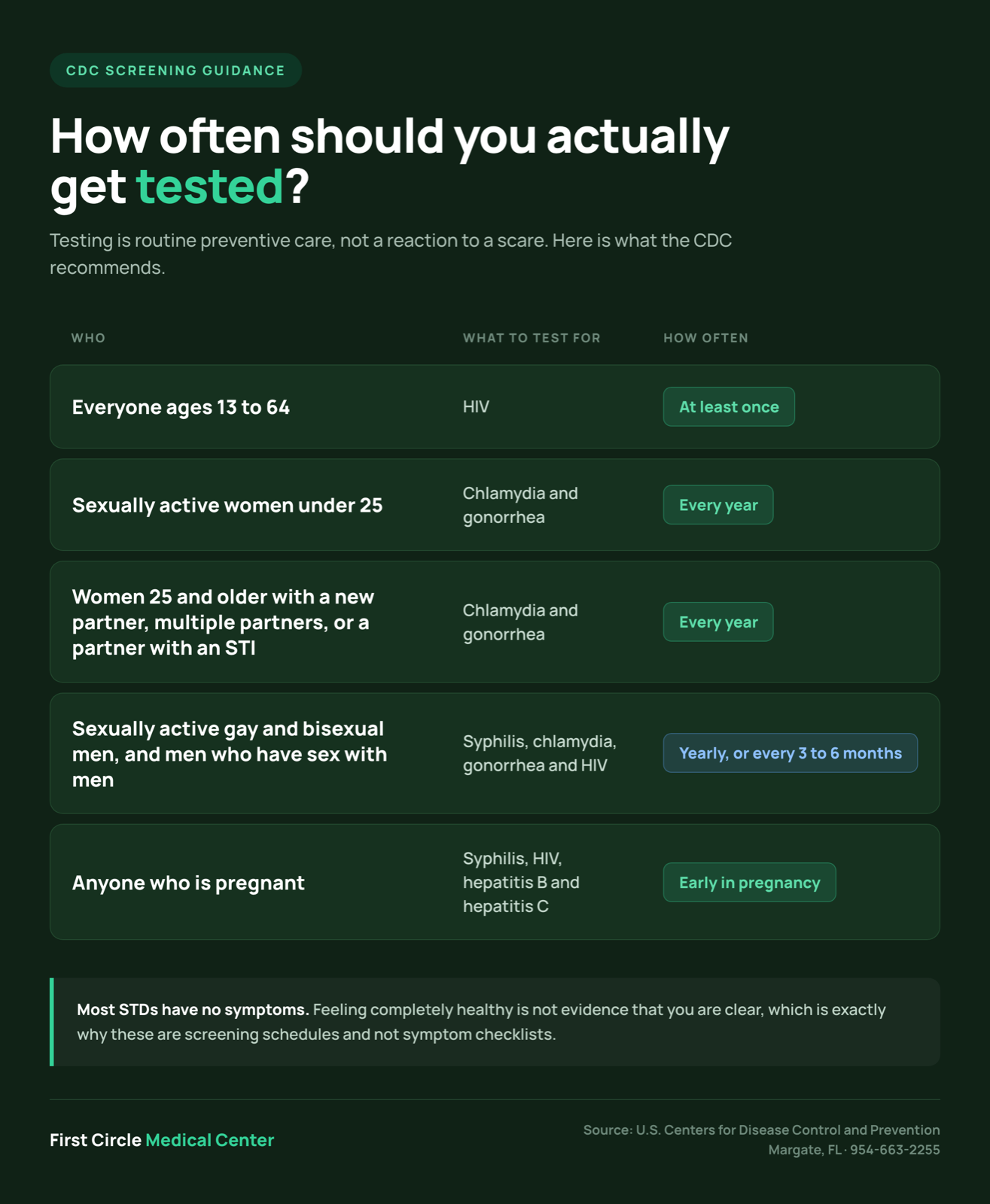
The fact: The number of partners is one factor, not the only one. The CDC recommends:
- Everyone aged 13 to 64 should be tested for HIV at least once.
- Sexually active women under 25 should be tested for chlamydia and gonorrhea every year.
- Women 25 and older with a new partner, multiple partners, or a partner with an STI should also be tested every year.
- Sexually active gay and bisexual men should be tested at least yearly, and every 3 to 6 months with multiple partners.
- Anyone who is pregnant should be tested for syphilis, HIV, hepatitis B and hepatitis C early in pregnancy.
A long, committed relationship does not automatically make testing unnecessary either. Many couples test together when a relationship begins, so they start with real answers instead of assumptions.
Myth 4: "A negative result means I am clear for good."
The fact: A test is a snapshot of one moment. Every infection has a window period, the gap between exposure and the point where a test can reliably detect it. Testing too soon after an exposure can come back negative even when an infection is present.
If you are testing because of a specific recent exposure, say so when you call. That one sentence tells our team which tests make sense now and when to schedule a repeat. Nobody here reacts to it. It is one of the most ordinary things we hear.
If your situation involves ongoing risk, regular testing every few months is how you stay current, not a one-time visit.
Myth 5: "STDs cannot be cured, so why bother?"
The fact: Several of the most common ones can be cured, and the rest can be managed very well when found early.
- Chlamydia, gonorrhea and syphilis are bacterial infections that are treated with antibiotics. Treatment works best when they are caught early.
- Hepatitis C is curable today with pills taken at home. Read our guide to Hepatitis C treatment in South Florida.
- HIV has no cure, but effective treatment lets people live long, healthy lives. The CDC reports that a person who takes HIV medicine as prescribed and keeps an undetectable viral load cannot pass HIV to a partner through sex.
- Prevention exists. PrEP is a medication that lowers the risk of getting HIV from sex by about 99 percent when taken as prescribed, and we offer it.
The point of testing is not to deliver bad news. It is to find something while it is simple to deal with.
Myth 6: "I cannot afford to get tested without insurance."
The fact: Cost is the most common reason people delay, and it is the most fixable.
- If you have coverage, we accept Medicare, Medicaid and most insurance plans. Preventive screening is frequently covered at little or no cost to you.
- If you are uninsured, ask about our Sliding Fee Scale. It applies to patients at or below 200 percent of the Federal Poverty Guidelines. You can fill out the paperwork in our office or call 954-663-2255.
- Call before you decide it is too expensive. One short phone call gets you a straight answer for your specific situation.
We are a doctor's office open to everyone, whatever your income. Skipping a visit to avoid a cost usually ends up costing more later.
Myth 7: "I will be judged, or someone will find out."
The fact: Your visit and your results are protected health information under HIPAA, and details of your care are not shared without your authorization except where the law requires. Our team talks about this every day. There is nothing you can say that will surprise anyone.
We provide care in English, Spanish and Creole. And if coming in person is the hard part, our telemedicine visits reach patients across Florida, including lab orders and STD testing kits. In-person care is in Margate and Broward County.

What to Do Next
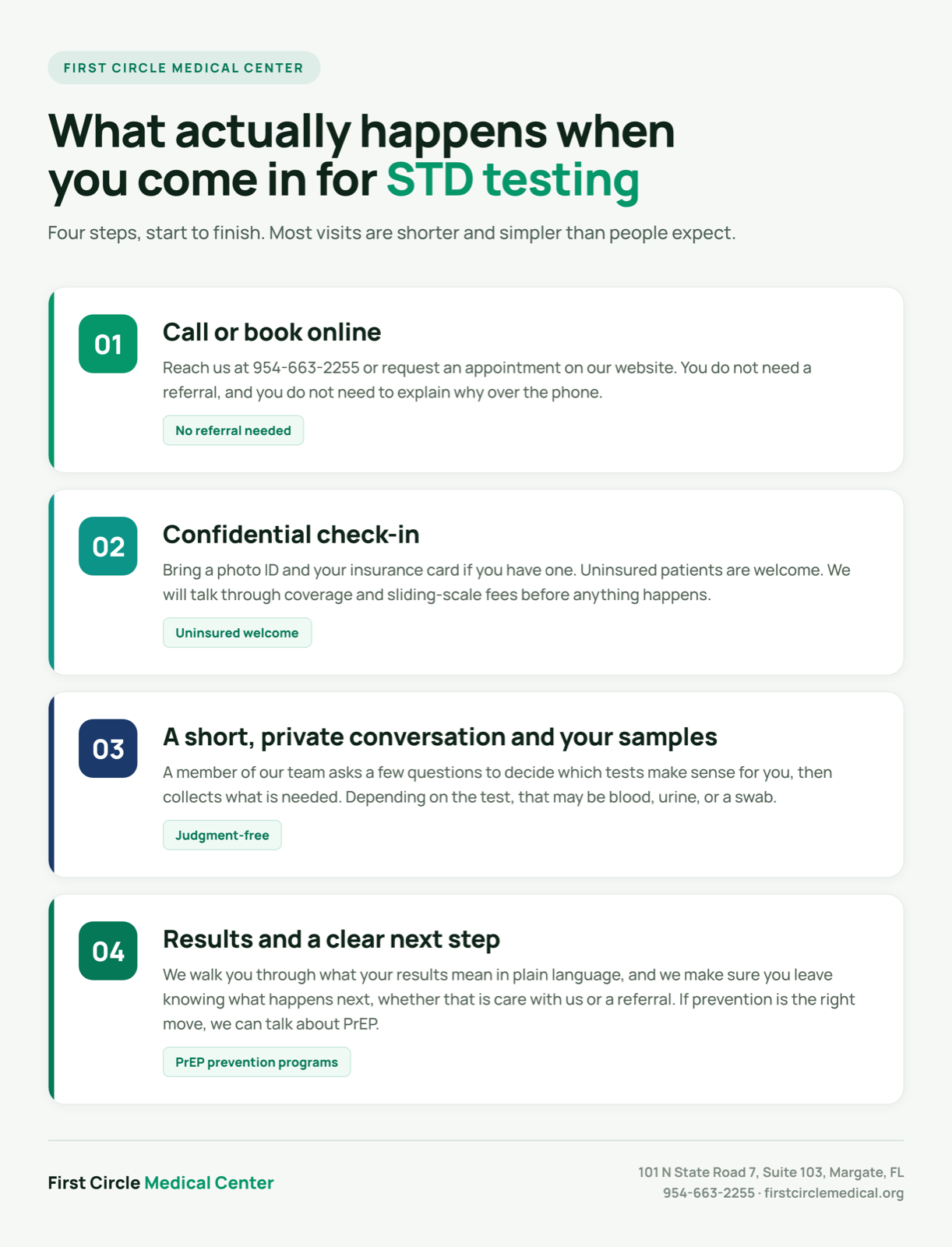
- Pick a day this week. Call 954-663-2255 or request an appointment online.
- Jot down rough dates. When you were last tested and when any possible exposure happened. Approximate is fine.
- Say what you want. "I would like to be tested for everything" is a perfectly good opening sentence.
- Book the follow-up before you leave. A repeat test, a results conversation, or a PrEP discussion goes on the calendar while you are still standing there.
For the full walkthrough of a visit, what it costs and how to choose where to go, see our guide to STD testing in Margate, FL.
Frequently Asked Questions
Where can I get STD testing in Margate, FL?
First Circle Medical Center offers confidential STD and HIV testing at 101 N State Road 7, Suite 103, Margate, FL 33063. We are open Monday through Friday, 9:00 AM to 5:00 PM, and Saturday by appointment only. Call 954-663-2255 to book. Telemedicine is available across Florida, including lab orders and STD testing kits.
Do I need symptoms to get tested for an STD?
No. Many STDs cause no symptoms at all, so you can carry an infection while feeling completely healthy. Testing is routine preventive care, and you do not need a reason or a referral to ask for a test.
How much does STD testing cost if I do not have insurance?
We accept Medicare, Medicaid and most insurance plans. If you are uninsured, our Sliding Fee Scale applies to patients at or below 200 percent of the Federal Poverty Guidelines. You can fill out the paperwork in the office or call 954-663-2255 to ask before your visit.
Sources: Screening recommendations are drawn from the U.S. Centers for Disease Control and Prevention, Getting Tested for STIs, and the CDC STI Treatment Guidelines.
This article is for general information and is not medical advice. Please speak with a qualified healthcare provider about your individual situation.